
Cubic Yards Calculator
- Square Footage
- Cubic Feet
- CBM
- Cubic Yards
Use this cubic yards calculator to calculate the amount of gravel, sand, mulch, concrete, compost or other material you might need for your project.

Disclaimer: Whilst every effort has been made in building our calculator tools, we are not to be held liable for any damages or monetary losses arising out of or in connection with their use. Full disclaimer.
People commonly want to know how many cubic yards of materials they need for a landscaping or construction project - whether it's concrete for a foundation, gravel for a driveway, or mulch for garden beds. Initially, working out the square footage area can seem quite straightforward, but then you're typically faced with a depth in inches, which requires a conversion and some mathematical know-how. In the article below, we'll walk you through the process of how we do the calculation. You can then use our calculator to check your answer.
How to calculate cubic yards
To calculate cubic yards we use the following formula:
Here's a quick step-by-step guide for how to make the calculation:
- Measure the width and length of the area in feet, then multiply them together to calculate the area in square feet.
- Decide the depth of materials (mulch, concrete, etc) that you want in inches.
- Divide your depth figure by 12 to convert it from inches to feet.
- Multiply your area figure (from step 1) by your depth figure (from step 3) to get cubic feet.
- Divide your cubic feet figure by 27 to get cubic yards.
Note: If your measurements are not in feet, you can convert them to feet using our length converter. Once you've done your calculation, feel free to check it against our cubic yards calculator at the top of this page.
Let's go through an example calculation to demonstrate our process in action.
Example calculation
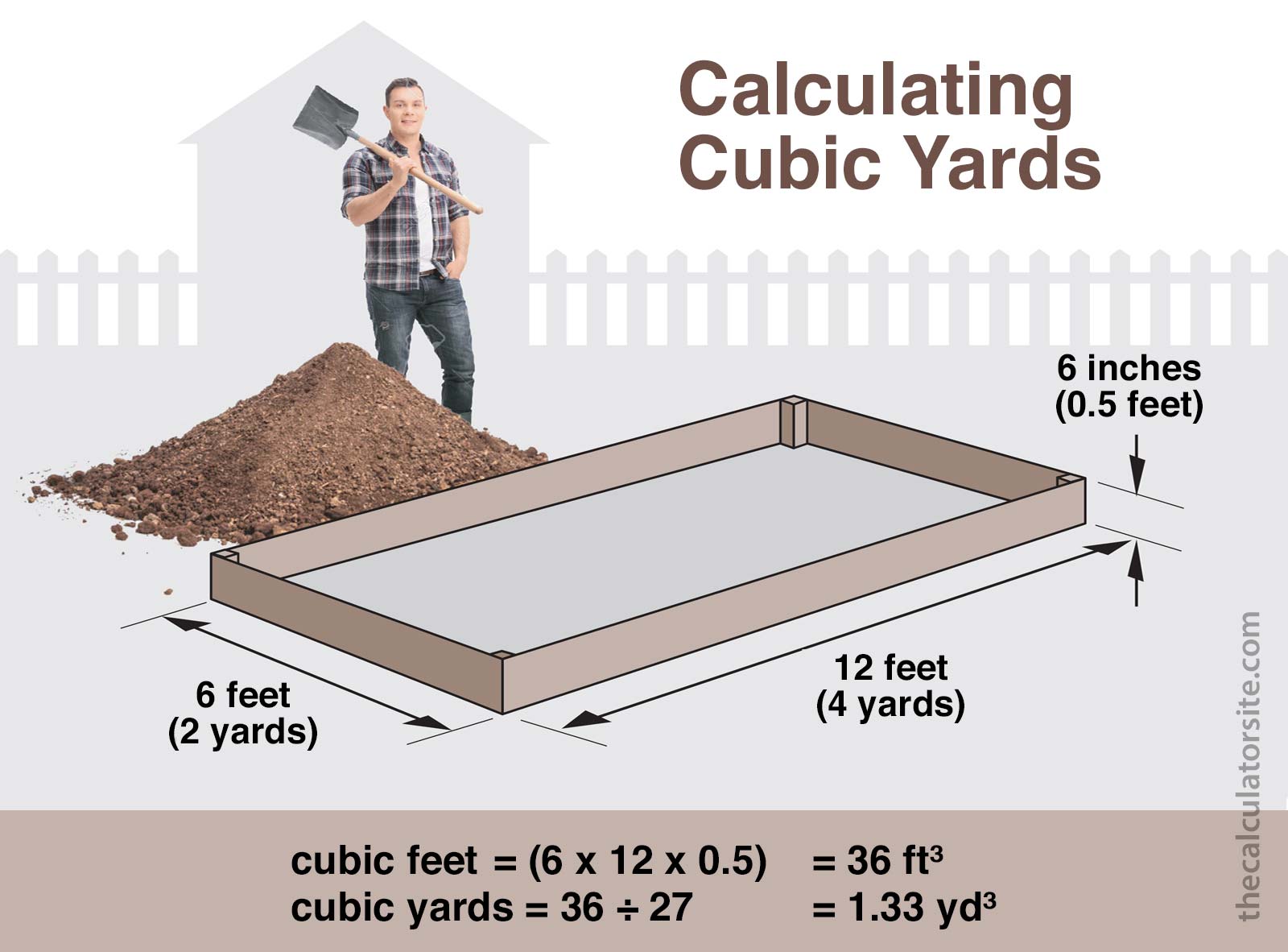
In our example above, the width of our garden bed is 10 feet, our length is 15 feet and we want to fill it with 6 inches of mulch. As there are 12 inches in a foot, we divide our depth figure by 12 to get 0.5 feet. This means our measurements are:
- Width: 10 feet
- Length: 15 feet
- Depth: 0.5 feet
To calculate cubic yards, we multiply 10 × 15 × 0.5 to get a total of 75 cubic feet. We then divide by 27 to get 2.78 cubic yards. And that's our answer.
| Depth (inches) | Coverage (sq ft) |
|---|---|
| 1 inch | 324 sq ft |
| 2 inches | 162 sq ft |
| 3 inches | 108 sq ft |
| 4 inches | 81 sq ft |
| 5 inches | 65 sq ft |
| 6 inches | 54 sq ft |
| 12 inches | 27 sq ft |
How to convert square feet to cubic yards
Now, it may be that you already have a square feet area figure and want to convert to cubic yards. In this case, simply multiply your square footage figure by the height/depth in feet. This gives you a result in cubic feet. Divide your result by 27 to get your cubic yards measurement. Simple.
And if you don't want to calculate this manually, we have a square feet to cubic yards calculator to help you.
How much will my cubic yard of materials weigh?
You've now calculated your cubic yards figure, but how can you work out how much your materials are going to weigh?
It's important to recognise that the weight of a cubic yard varies significantly depending on the material – a cubic yard of mulch weighs far less than a cubic yard of concrete, for example. We've put together a quick reference guide below for common landscaping and construction materials, to assist you.
Alternatively, if you want a more precise conversion, or want to calculate the weight of other materials, you can use our cubic yards to tons calculator instead. This tool contains density estimates for a wide range of materials (with weights given in both tons and pounds).
| Material | Weight per Cubic Yard |
|---|---|
| Mulch | 400-800 lbs |
| Topsoil (dry) | 1,800-2,200 lbs |
| Gravel | 2,300-2,900 lbs |
| Sand (dry) | 2,600-3,000 lbs |
| Concrete | 3,600-4,050 lbs |
Please note that the weights we've listed are estimates based on standard material densities and may vary by moisture content and compaction.
I hope this page and calculator have helped you calculate the cubic yards needed for your project.
If you have any problems using our cubic yards calculator, please contact us.