
Compound Interest Calculator
 Creator: Alastair Hazell.
Reviewed: Chris Hindle, Chartered ALIBF.
Creator: Alastair Hazell.
Reviewed: Chris Hindle, Chartered ALIBF.
Use our popular calculator to see how compounding can grow your savings or investments over time. Hand-coded since 2010 and developed through user feedback, our calculator has been used by millions worldwide and featured in leading financial publications.
- Compound Interest
- Simple Interest
- Daily Compound
- Forex Compound
Interest calculation for 5 years
$6,416.79 Total interest earned
$1,416.79 Initial balance
$5,000.00
28.34% The RoR represents the profit or loss % returned from your investment over the entire investment term. Learn more.
13 years, 11 months
Interest rate:5% yearly
Effective Rate:5.12%
Compounding:Monthly
- Start investing early.
- Make regular contributions if possible.
- Consider tax-efficient savings products with more frequent compounding.
- What is compound interest? | Investing for compound interest
| Month | Deposits & Withdrawals | Interest | Total Deposits & Withdrawals | Accrued Interest | Balance |
|---|---|---|---|---|---|
| 0 | $5,000.00 | – | $5,000.00 | – | $5,000.00 |
| 1 | $20.83 | $20.83 | $5,020.83 | ||
| 2 | $20.92 | $41.75 | $5,041.75 | ||
| 3 | $21.01 | $62.76 | $5,062.76 | ||
| 4 | $21.09 | $83.86 | $5,083.86 | ||
| 5 | $21.18 | $105.04 | $5,105.04 | ||
| 6 | $21.27 | $126.31 | $5,126.31 | ||
| 7 | $21.36 | $147.67 | $5,147.67 | ||
| 8 | $21.45 | $169.12 | $5,169.12 | ||
| 9 | $21.54 | $190.66 | $5,190.66 | ||
| 10 | $21.63 | $212.28 | $5,212.28 | ||
| 11 | $21.72 | $234.00 | $5,234.00 | ||
| 12 | $21.81 | $255.81 | $5,255.81 | ||
| 13 | $21.90 | $277.71 | $5,277.71 | ||
| 14 | $21.99 | $299.70 | $5,299.70 | ||
| 15 | $22.08 | $321.78 | $5,321.78 | ||
| 16 | $22.17 | $343.96 | $5,343.96 | ||
| 17 | $22.27 | $366.22 | $5,366.22 | ||
| 18 | $22.36 | $388.58 | $5,388.58 | ||
| 19 | $22.45 | $411.03 | $5,411.03 | ||
| 20 | $22.55 | $433.58 | $5,433.58 | ||
| 21 | $22.64 | $456.22 | $5,456.22 | ||
| 22 | $22.73 | $478.95 | $5,478.95 | ||
| 23 | $22.83 | $501.78 | $5,501.78 | ||
| 24 | $22.92 | $524.71 | $5,524.71 | ||
| 25 | $23.02 | $547.73 | $5,547.73 | ||
| 26 | $23.12 | $570.84 | $5,570.84 | ||
| 27 | $23.21 | $594.05 | $5,594.05 | ||
| 28 | $23.31 | $617.36 | $5,617.36 | ||
| 29 | $23.41 | $640.77 | $5,640.77 | ||
| 30 | $23.50 | $664.27 | $5,664.27 | ||
| 31 | $23.60 | $687.87 | $5,687.87 | ||
| 32 | $23.70 | $711.57 | $5,711.57 | ||
| 33 | $23.80 | $735.37 | $5,735.37 | ||
| 34 | $23.90 | $759.27 | $5,759.27 | ||
| 35 | $24.00 | $783.26 | $5,783.26 | ||
| 36 | $24.10 | $807.36 | $5,807.36 | ||
| 37 | $24.20 | $831.56 | $5,831.56 | ||
| 38 | $24.30 | $855.86 | $5,855.86 | ||
| 39 | $24.40 | $880.26 | $5,880.26 | ||
| 40 | $24.50 | $904.76 | $5,904.76 | ||
| 41 | $24.60 | $929.36 | $5,929.36 | ||
| 42 | $24.71 | $954.07 | $5,954.07 | ||
| 43 | $24.81 | $978.87 | $5,978.87 | ||
| 44 | $24.91 | $1,003.79 | $6,003.79 | ||
| 45 | $25.02 | $1,028.80 | $6,028.80 | ||
| 46 | $25.12 | $1,053.92 | $6,053.92 | ||
| 47 | $25.22 | $1,079.15 | $6,079.15 | ||
| 48 | $25.33 | $1,104.48 | $6,104.48 | ||
| 49 | $25.44 | $1,129.91 | $6,129.91 | ||
| 50 | $25.54 | $1,155.45 | $6,155.45 | ||
| 51 | $25.65 | $1,181.10 | $6,181.10 | ||
| 52 | $25.75 | $1,206.86 | $6,206.86 | ||
| 53 | $25.86 | $1,232.72 | $6,232.72 | ||
| 54 | $25.97 | $1,258.69 | $6,258.69 | ||
| 55 | $26.08 | $1,284.77 | $6,284.77 | ||
| 56 | $26.19 | $1,310.95 | $6,310.95 | ||
| 57 | $26.30 | $1,337.25 | $6,337.25 | ||
| 58 | $26.41 | $1,363.65 | $6,363.65 | ||
| 59 | $26.52 | $1,390.17 | $6,390.17 | ||
| 60 | $26.63 | $1,416.79 | $6,416.79 |
| Year | Deposits & Withdrawals | Interest | Total Deposits & Withdrawals | Accrued Interest | Balance |
|---|---|---|---|---|---|
| 0 | $5,000.00 | – | $5,000.00 | – | $5,000.00 |
| 1 | $255.81 | $255.81 | $5,255.81 | ||
| 2 | $268.90 | $524.71 | $5,524.71 | ||
| 3 | $282.65 | $807.36 | $5,807.36 | ||
| 4 | $297.12 | $1,104.48 | $6,104.48 | ||
| 5 | $312.32 | $1,416.79 | $6,416.79 |
Our compound interest calculator provides both monthly and yearly interest projections and allows you to include both regular deposits and withdrawals, which can be adjusted with inflation. Got questions? Just ask. Continue scrolling to learn about compound interest, how it's calculated and how to make it work for you.

Disclaimer: Whilst every effort has been made in building our calculator tools, we are not to be held liable for any damages or monetary losses arising out of or in connection with their use. Full disclaimer.
What is compound interest?
I think compound interest is one of the fundamental concepts to understand when it comes to saving and long-term wealth building. Compound interest, or 'interest on interest', means that accumulated interest is added back onto the principal sum, with future interest being calculated on both the original principal and the previously earned interest.
This compounding effect causes investments to grow faster over time, much like a snowball gaining size as it rolls downhill. You can see the compounding in action in the example table below, as the interest figure grows year on year. We're using a $1,000 investment at a realistic 5% savings rate (compounded yearly).
| Year | Interest Earned | End Balance |
|---|---|---|
| 1 | $50.00 | $1,050.00 |
| 2 | $52.50 | $1,102.50 |
| 3 | $55.13 | $1,157.63 |
| 4 | $57.88 | $1,215.51 |
| 5 | $60.78 | $1,276.28 |
| 6 | $63.81 | $1,340.10 |
| 7 | $67.00 | $1,407.10 |
| 8 | $70.36 | $1,477.46 |
| 9 | $73.87 | $1,551.33 |
| 10 | $77.57 | $1,628.89 |
Unlike simple interest (which is calculated only on the principal), compound interest is calculated on both the initial investment and the already-accumulated interest. As a result, each year's interest is higher than the last. This is what makes compounding so powerful for long-term growth.
When you then introduce regular, consistent investing into the mix over a sustained period of time, the effects of compound interest are amplified further, giving your savings or investments real long-term acceleration.
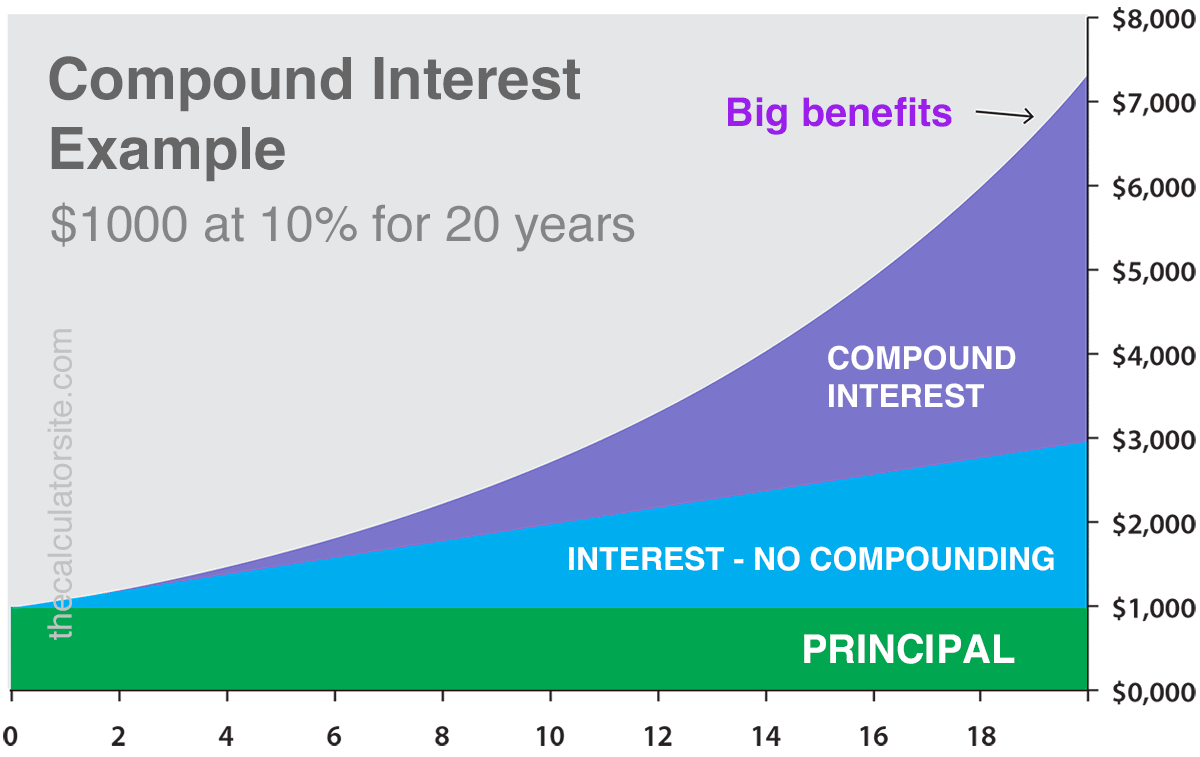
To illustrate the effect of compounding further, let's take a look at an example line chart using that initial $1,000 investment again. This time we'll use a 20 year investment term at a 10% annual interest rate (just for simplicity). As you compare the compound interest line to those for standard interest and no interest at all, you can see how compounding boosts the investment value.
Making compound interest work for you
We've covered what compound interest is, but how do you make the most of it? Here are a few strategies to keep in mind:
- Start Early: Time plays an important role in compound interest. So, starting your investments early, even with smaller amounts, gives your money more time to grow and for the interest to compound.
- Regular Contributions: By consistently adding to your investment, you enhance the compounding effect - like a snowball that grows larger with every roll. Each new contribution starts earning its own interest, adding to the overall growth.
- Higher Compounding Frequencies: When evaluating savings or investment options, pay attention to those that compound more frequently. The more often interest is compounded, the greater the potential for growth (although the difference may be minimal at lower interest rates).
Three simple strategies to consider when doing your long-term financial planning.
How is compound interest calculated?
So, we know that compound interest can be incredibly powerful, but how exactly is it calculated? Let's take a look.
Compound interest works by adding earned interest back to the principal. This generates additional interest in the periods that follow, which accelerates your investment growth.
The formula used for calculating compound interest is:
Where:
- A = the future value of the investment
- P = the principal balance
- r = the annual interest rate (decimal)
- n = number of times interest is compounded per year
- t = the time in years
- ^ = ... to the power of ...
For example, if you want to calculate monthly compound interest, simply divide the annual interest rate by 12 (the number of months in a year), add 1, and raise the result to the power of 12 * t (years).
If you'd prefer not to do the math manually, you can use the compound interest calculator at the top of our page. Simply enter your principal amount, interest rate, compounding frequency and the time period. You can also include regular deposits or withdrawals to see how they impact the future value.
See also: Savings Goal Calculators | Investment Calculator | Loan Calculator
Example: $10,000 invested for 20 years at 5%
We've discussed what compound interest is and how it is calculated. So, let's now break down interest compounding by year, using a more realistic example scenario. We'll say you have $10,000 in a savings account earning 5% interest per year, with annual compounding. We'll assume you intend to leave the investment untouched for 20 years. Your calculation might look like this...
| Year | Interest Calculation | Interest Earned | End Balance |
|---|---|---|---|
| Year 1 | $10,000 x 5% | $500 | $10,500 |
| Year 2 | $10,500 x 5% | $525 | $11,025 |
| Year 3 | $11,025 x 5% | $551.25 | $11,576.25 |
| Year 4 | $11,576.25 x 5% | $578.81 | $12,155.06 |
| Year 5 | $12,155.06 x 5% | $607.75 | $12,762.82 |
| Year 6 | $12,762.82 x 5% | $638.14 | $13,400.96 |
| Year 7 | $13,400.96 x 5% | $670.05 | $14,071 |
| Year 8 | $14,071 x 5% | $703.55 | $14,774.55 |
| Year 9 | $14,774.55 x 5% | $738.73 | $15,513.28 |
| Year 10 | $15,513.28 x 5% | $775.66 | $16,288.95 |
| Year 11 | $16,288.95 x 5% | $814.45 | $17,103.39 |
| Year 12 | $17,103.39 x 5% | $855.17 | $17,958.56 |
| Year 13 | $17,958.56 x 5% | $897.93 | $18,856.49 |
| Year 14 | $18,856.49 x 5% | $942.82 | $19,799.32 |
| Year 15 | $19,799.32 x 5% | $989.97 | $20,789.28 |
| Year 16 | $20,789.28 x 5% | $1,039.46 | $21,828.75 |
| Year 17 | $21,828.75 x 5% | $1,091.44 | $22,920.18 |
| Year 18 | $22,920.18 x 5% | $1,146.01 | $24,066.19 |
| Year 19 | $24,066.19 x 5% | $1,203.31 | $25,269.50 |
| Year 20 | $25,269.50 x 5% | $1,263.48 | $26,532.98 |
So, $10,000 invested at a fixed 5% yearly interest rate, compounded yearly, will grow to $26,532.98 after 20 years. This means total interest of $16,532.98 and a return on investment of 165%.
It's important to remember that we've assumed a fixed percentage yearly interest rate in the example above. Real-life returns are rarely as predictable as this. If you are investing your money, rather than saving it in fixed rate accounts, the reality is that returns on your investment will vary year on year due to factors like interest rate fluctuations, market conditions, inflation, and other economic factors.
This is why financial experts commonly suggest the risk management strategy of diversification.
Compounding with additional deposits
As we discussed in our section about growth strategies, combining interest compounding with regular deposits is a highly efficient strategy that can really boost the growth of your money in the longer term.
Looking back at our example from above, if we were to contribute an additional $100 per month into our investment, our balance after 20 years would hit the heights of $67,121, with interest of $33,121 on total deposits of $34,000.
As financial institutions point out, if people begin making regular investment contributions early on in their lives, they can see significant growth in their savings further down the road as their interest snowball gets larger and they gain benefit from Dollar-cost or Pound-cost averaging. 2
Note that you can include regular weekly, bi-weekly (fortnightly), monthly, quarterly or yearly deposits in your calculations with our compound interest calculator at the top of the page.
Where to invest for compound interest
The question about where to invest to benefit from compound interest has become a feature of our email inbox here at The Calculator Site. There are many options to consider, including mutual funds, ETFs, and high-yield savings accounts in the US, and ISAs, unit trusts, and high-yield savings accounts in the UK, and, understandably, people want to know the advantages and risks of each.
Although we work to develop quality tools to assist you with your financial calculations, we can't advise you about where to invest your money to achieve the best returns. Instead, we recommend you speak to a qualified financial advisor for guidance based upon your own circumstances.
There are also some excellent articles from renowned financial websites that list common types of investment for compound interest and compound growth. Here are some of the best articles, to help with your research:
- Compound Interest Investments For 2026 (US). Forbes.
- Accounts That Earn Compounding Interest (US). Motley Fool.
- Best Compound Interest Investments in the UK (UK). The Investors Centre.
FAQ
Let's cover some frequently asked questions about our compound interest calculator.
Can I include regular contributions in my calculation?
Yes. You can include regular deposits and regular withdrawals within your compound interest calculation. Withdrawals can be made as either a monetary figure or as a percentage of interest or earnings. You can also combine both regular deposits and withdrawals if you so wish.
You may, for example, want to include regular monthly deposits whilst withdrawing a yearly percentage of interest to account for tax. Or, you may be considering retirement and wondering how long your money might last with regular withdrawals.
What is the effective annual interest rate?
The effective annual rate (also known as the annual percentage yield) is the rate of interest that you actually receive on your savings or investment after compounding has been factored in.
When interest compounding takes place, the effective annual rate becomes higher than the nominal annual interest rate. The more times the interest is compounded within the year, the higher the effective annual interest rate will be.
What is RoR/TWR?
Within our compound interest calculator results section, you will see either a Rate of Return (RoR) or Time-Weighted Return (TWR) figure for your calculation. You may be wondering what these are, so let's quickly discuss this.
The Rate of Return (RoR) reflects the percentage return on your investment over the entire investment term. We calculate it by taking the Initial investment figure away from the Final value and dividing the resulting figure by the Initial investment. 3
If you include regular deposits or withdrawals in your calculation, we switch to provide you with a Time-Weighted Return (TWR) figure. 4
The TWR figure represents the cumulative growth rate of your investment. It is calculated by breaking out each period's growth individually to remove the effects of any additional deposits and withdrawals. The TWR gives you a clearer picture of how your investment might have performed if you hadn't made extra deposits or withdrawn funds, allowing you to better assess its overall performance. You can learn more about TWR in this article by JP Morgan.
If you want to head back up to the calculator results area, you can click the link here.
A final word
I hope you found this article helpful and that it has shown you how powerful compounding can be – and why Warren Buffett swears by it.
As a final note, many of the features in my compound interest calculator have come as a result of user feedback. So, if you have any comments or suggestions, we would love to hear from you.
By Alastair Hazell Updated: August 19, 2026References
- Using online compound interest tools to improve financial literacy, The Journal of Economic Education.
- How to take advantage of compound growth. Canada Life.
- Rate of return. CFI Education Inc.
- How to Use the Time-Weighted Rate of Return (TWR) Formula. Investopedia.